
ESO MIA Unit Equips Project Leaders on Standardized Extension Processes
September 2, 2026
USM Experts Train Columbio Coalmen on Charcoal Briquette Making to Control Invasive Piper aduncum
September 2, 2026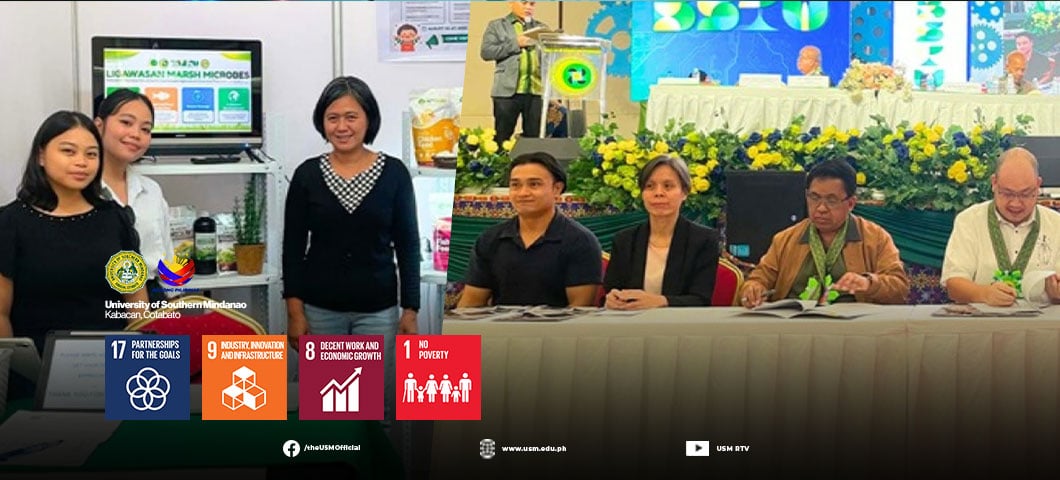
Cotabato City, BARMM—The University of Southern Mindanao (USM) officially partnered with the Bangsamoro Government’s Ministry of Science and Technology (MOST-BARMM) to advance research and development across the Bangsamoro Autonomous Region in Muslim Mindanao (BARMM). This collaboration was formalized through the signing of a Memorandum of Agreement (MOA) on August 25, 2026, at the KCC Mall of Cotabato City.
The MOA signing took place during the 2026 Bangsamoro Science and Technology Week (BSTW)—an annual event held from August 25 to 27, 2026, and organized by MOST-BARMM to showcase regional advancements in science, technology, and innovation.
Representing USM, Dr. Debbie Marie B. Verzosa, Vice President for Research, Development, and Extension, signed the MOA alongside institutional leaders, including Fr. Francis Efren C. Zabala, OMI, DMin, President of Notre Dame University, and Casiano H. Choresca, Jr., Scientist I and Chief of the Brackishwater Fisheries Research and Development Center under the National Fisheries Research and Development Institute (NFRDI).
USM’s involvement in the initiative centers on the approval of the project “RIPLED-BARMM: Research Into Parasites in Livestock for Economic Development of BARMM,” led by Dr. Jan Clyden B. Tenorio. The project aims to assess the epidemiology of key parasitic infections in BARMM livestock, seeking to boost animal productivity while building local confidence in livestock farming as a viable source of income.
Beyond the signing ceremony, the 2026 BSTW opened its doors to partner institutions for a week-long exhibition. USM’s active participation featured two booth exhibits of MOST-BARMM-funded projects, highlighting institutional research, technologies, and agricultural innovations.
This established partnership with BARMM underscores USM’s dedication to building strategic alliances that bolster research and development initiatives across Mindanao. Beyond formalizing this collaboration, the project directly connects academic research to field-level solutions and community impact.