

Amat-Amat Lang: Rainier Clyde Salanap’s Journey to Highest Honors and Purpose
March 15, 2026
USM-DELL Spearheads 2nd Round of Campus Journalism Training in Bacong
March 16, 2026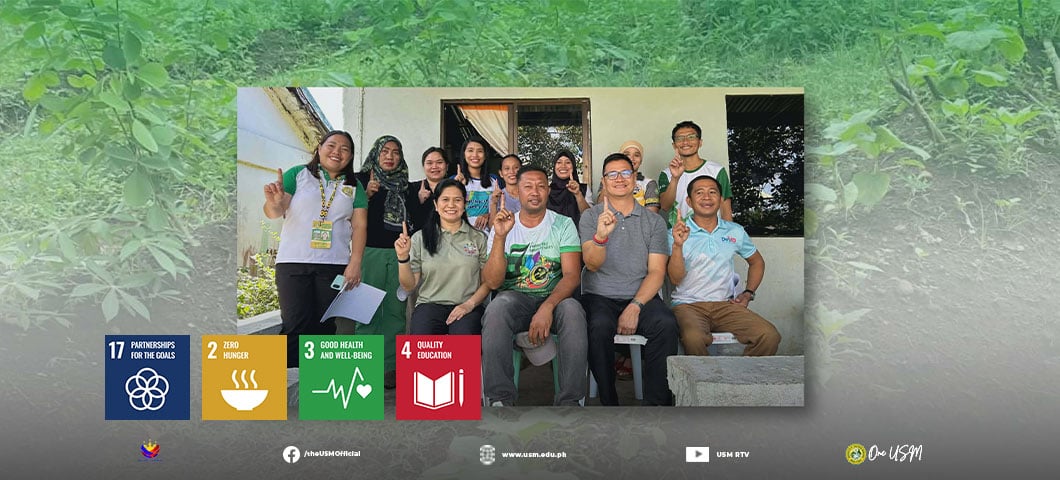
KABACAN, COTABATO — The University of Southern Mindanao (USM)-Extension Services Office (ESO), in collaboration with the College of Agriculture (CA) and the SOCCSKSARGEN Agriculture, Aquatic and Natural Resources Research and Development Consortium (SOXARRDEC), reaffirmed its commitment to community-based education and sustainable agriculture during a monitoring visit for the extension project, “Plant to Learn: Establishment of Vegetable, Herbs, Spices, Medicinal Plants, and Forage Garden at Nangaan National High School.”
Conducted on March 11, 2026, the activity was led by Project Leader Monaira I. Sumael, alongside Training Specialist Ritchel O. Torres and SOXARRDEC Director Julius Jerome G. Ele.
During the visit, the monitoring team reviewed the project’s milestones and evaluated how hands-on activities are bridging the gap between classroom theory and actual agricultural practice for both students and teachers. For Gulayan sa Paaralan Coordinator Miss Anis Dilanggalin, the extension project serves as a vital lifeline that transforms the school grounds into a hub of food self-sufficiency and communal cooperation.
“Malaki ang naitulong ng hardin sa paaralan at sa komunidad dahil ang aming mga mag-aaral at guro ay nakapaghaharvest ng sariwang gulay para sa kanilang pagkain, habang tumutulong din ang mga miyembro ng komunidad sa paghahanda at pagpapanatili ng lugar ng taniman,” she expressed.
Despite the visible success, Dilanggalin highlighted critical hurdles in maintaining the garden’s longevity. The lack of a robust perimeter fence remains a primary concern, as wandering livestock—including goats, cows, and carabaos—frequently enter the area and damage the crops. Additionally, limited resources for consistent maintenance pose a threat to the garden’s expansion.
The ‘Plant to Learn’ project aims to establish a school-based learning garden featuring vegetables, herbs, spices, medicinal plants, and forage crops. This initiative directly supports the Gulayan sa Paaralan Program, a national strategy designed to bolster food security, heighten nutrition awareness, and instill a culture of sustainable farming among the youth.
Through the enduring partnership of USM, SOXARRDEC, and Nangaan National High School, the project continues to push forward, aiming to cultivate not only resilient crops but also a deep-seated appreciation for agriculture among young learners. This underscored the pivotal role of school-based agriculture in building a food-secure future, ensuring that the next generation is equipped to turn local lands into sustainable sources of healthy produce.
